A team of researchers and psychologists who specialize in behavioral health and neuroscience. This group collaborates to produce insightful and evidence-based content.
Certified recovery coach specialized in helping everyone redefine their relationship with alcohol. His approach in coaching focuses on habit formation and addressing the stress in our lives.
Recognized by Fortune and Fast Company as a top innovator shaping the future of health and known for his pivotal role in helping individuals change their relationship with alcohol.
July 1, 2024
·
20
Reframe Content Team
July 1, 2024
·
20
Ben Affleck’s Story Gives Us a Realistic View of Recovery
Ben Affleck’s story documents his journey through alcohol addiction and multiple relapses — reminding us that the path to sobriety isn’t always smooth.
We can prevent and bounce back from a relapse by understanding the recovery process, recognizing our triggers, developing a support team, practicing self-care, and remembering our “why.”
Reframe offers 24/7 encouragement, knowledge, and support for us to overcome challenges that may arise on our journey to sobriety!
Seeing a headline about a "ben affleck drunk" moment can feel like simple celebrity gossip. But what's really happening behind the camera? His public journey with alcohol, including questions like "did ben affleck relapse," offers a raw and honest look at recovery. It’s not a straight line to success. Each time the world sees a potential ben affleck relapse, we're not just seeing a misstep. We're seeing a real person managing a chronic condition under a microscope, showing what it truly means to keep fighting.
While tabloid news is mostly gossip, there’s much to learn from Affleck’s story of addiction and recovery. Let’s pull back the curtain on Affleck’s story to see what lessons we can apply to our own journey.
Understanding Ben Affleck's Relapse and Recovery Journey
In 1998, Ben Affleck shared the Academy Award for Best Original Screenplay for Good Will Hunting with his co-star and childhood pal, Matt Damon. Around that same time, Affleck announced in an interview that he had stopped drinking alcohol after reflecting on the negative behaviors he displayed when he was drunk. A few years later, in 2001, soon after parting ways with actress Gwyneth Paltrow, he recalled a stint of nonstop partying and gambling. Before long he was checking into a 30-day rehab program in Malibu, California.
After the program, Affleck claims to have had a “normal” relationship with drinking. His acting career continued to flourish; he married actress Jennifer Garner; and they started a family. In 2015, Affleck and Garner separated. He eventually shared that his drinking had played a role in their separation and that he had worked with a sobriety coach in 2017 in hopes of being a better father to their children. In 2018, the same year the couple officially divorced, Garner was seen taking Affleck to a rehab treatment facility.
About a year later, in 2019, Affleck was spotted leaving a Halloween party intoxicated and publicly acknowledged his relapse. While Affleck admits that having his story shared in public has its pros and cons, he is now in a position where others often reach out to him for help.
The Long Road to Self-Admission
One of the most challenging parts of changing your relationship with alcohol is admitting to yourself that there’s a problem in the first place. For Ben Affleck, this was a significant hurdle. He has shared that it took him a long time to fully accept that he was an alcoholic. This internal battle is something many people face. It’s easy to rationalize behavior or believe you have everything under control, especially when you’re functioning well in other areas of your life. Acknowledging that your drinking habits are causing harm requires a level of honesty and vulnerability that can feel overwhelming, but it’s the essential first step toward making a positive change.
Feeling Trapped and the Progression to Daily Drinking
Affleck’s struggle was compounded by other personal challenges, including depression, marital problems, and a family history of addiction. When you’re dealing with immense pressure or emotional pain, alcohol can feel like a temporary escape. This can create a difficult cycle: you drink to cope with problems, but the drinking itself creates more problems, leading to a feeling of being trapped. For Affleck, this pattern contributed to his drinking becoming a daily habit. This progression is common, as what starts as a way to unwind can slowly become a dependency that feels impossible to break without the right tools and support.
Accepting Alcoholism as a Chronic Condition
A pivotal shift in Affleck’s recovery was his acceptance of alcoholism as a chronic condition that requires ongoing management. He views it not as a one-time problem to be solved, but as something that needs daily attention. This perspective is incredibly powerful because it removes the pressure of a “perfect” recovery. Instead of seeing sobriety as a finish line you cross once, it becomes a practice you cultivate every day. This approach encourages self-compassion and persistence, recognizing that the goal is long-term well-being, not a temporary fix. It reframes the journey as one of continuous growth and self-awareness.
A Timeline of His Struggle with Alcohol
Ben Affleck’s journey with alcohol has been a public one, marked by periods of sobriety and relapse that span decades. His first attempt to quit drinking was in 1997, after he realized he regretted his actions while intoxicated. A few years later, in 2001, he sought professional help for the first time and entered a 30-day rehabilitation program. This timeline highlights a crucial reality of recovery: it is rarely a straight line. For many, the path involves multiple attempts and different approaches over several years. Understanding this can help normalize the ups and downs you might experience in your own journey.
Early Attempts at Sobriety
After his first rehab stay in 2001, Affleck believed he could return to drinking “like a normal person.” He managed this for about eight years before his consumption escalated again. This is an incredibly common and relatable part of the recovery process. Many people hope that after a period of abstinence, they can successfully moderate their drinking. For some, mindful drinking is an achievable goal, but for others, it can be a slippery slope back to old habits. Affleck’s experience shows how difficult it can be to find that line and the importance of being honest with yourself about what truly works for your well-being.
The Cycle of Abstinence and Relapse
Relapse is a part of many recovery stories, including Affleck’s. He has openly admitted that relapsing was embarrassing, but he didn’t let it stop him from seeking help again. This is perhaps the most important lesson from his journey. A setback is not a sign of failure; it’s an opportunity to learn, regroup, and strengthen your commitment. The key is to treat it as a data point, not a dead end. Reaching out for support, whether from friends, family, or a dedicated community, is crucial for getting back on track and continuing to move forward in a positive direction.
Is Ben Affleck Drinking Again? A Look at His Sobriety
Affleck has acknowledged relapsing multiple times in recovery. His last reported relapse occurred in 2019.
In 2023, the media speculated that he had been drunk at the Grammy Awards — which he later denied. Affleck claims to remain sober to this day.
Navigating Public Scrutiny and Stigma
The 2023 Grammys and Misinterpretation
Anyone who’s been the sober person at a party can probably relate to Ben Affleck’s experience at the 2023 Grammys. After photos of him looking bored went viral, the internet immediately assumed he was drunk or miserable. Affleck later addressed the speculation, confirming he was sober and simply tired at the event. He pointed out the irony that in his past, when he actually was drunk at award shows, no one ever called him out. Now that he’s sober, any expression other than perfect happiness is scrutinized and misinterpreted. His experience is a powerful reminder of the pressure to perform and the snap judgments people face when they choose not to drink in social settings.
The "Poster Boy" for Recovery
Being so open about his journey has turned Affleck into what he calls a “poster boy” for actor alcoholism and recovery — a role he never asked for. He acknowledges that this has a positive side; being a public figure allows him to help others, which in turn supports his own sobriety. However, it also comes with intense public stigma, leading him to advise other celebrities to keep their struggles private. This dilemma isn't unique to Hollywood. Deciding who to tell about your journey with alcohol is a deeply personal choice, and the fear of judgment is real. It underscores the need for a supportive circle where you can be open without facing the court of public opinion.
What Did Ben Affleck's Rehab Treatment Involve?
Affleck has checked into rehab multiple times over the years.
2001. Affleck attended a 30-day rehab program at Promises in Malibu, dropped off by his friend and fellow actor Charlie Sheen.
2017. Affleck announced that he had completed treatment for alcohol addiction. He was spotted with a sobriety coach and private detox nurse.
2018. His former wife, Jennifer Garner, took Affleck to The Canyon at Peace Park, a rehab facility in Malibu. A source later shared that it was a crisis situation.
While relapse is a common experience in recovery, Affleck’s life in the limelight may have played a role. Let’s get a better picture of what may have led to the star’s multiple relapses.
Why Did Ben Affleck Relapse? Exploring the Triggers
Alcohol consumption is commonly influenced by two components — genetics and environmental factors. Genetic disposition can set the scene for alcohol misuse, and environmental factors can exacerbate drinking habits. Let’s take a look at factors that may have triggered Affleck’s relapses.
The Role of Family History and Genetics
Affleck has a long history of substance use disorder in his family. In an interview with People magazine, Affleck shared that two of his grandparents along with other family members struggled with alcohol and other substance use disorders.
Notably, Affleck’s father battled with alcohol use disorder (AUD) until he committed to sobriety when Aflleck was 19. Affleck later recounted that his father’s alcohol misuse throughout his childhood had a major effect on him.
Research shows that those with a family history of alcohol use disorder are at a higher risk of developing AUD. Not only does family history affect the risk of AUD, but a study on AUD recurrence also found that family history of AUD can play a role in the risk of relapse. In interviews following his relapses, Affleck shared more of his family history, partially attributing his struggles and relapses to his experiences growing up. What else impacted Affleck’s drinking habits?
Hollywood Pressure and Personal Stressors
Living and working in an environment where drinking is highly normalized, coupled with the stress of public scrutiny, created the perfect storm for Affleck’s alcohol misuse. Early in his career, his personal and professional life revolved around environments where alcohol was prevalent, affecting his behavior and decision making. As he shared on The Hollywood Reporter’s “Awards Chatter” podcast, he’d worked with actors who showed up on the set drunk, which is the “most normal thing in Hollywood.”
Much of Ben Affleck’s journey with sobriety and relapse became public gossip and, he noted, that added to the pressure. Celebrities, like Affleck, who have shared their stories have helped to normalize the nonlinear journey to sobriety. However, according to Affleck, “alcoholics” and relapses during recovery continue to be stigmatized.
The Impact of His Career on His Drinking
Living and working in an environment where drinking is highly normalized, coupled with the stress of public scrutiny, can create a perfect storm for alcohol misuse. Early in his career, Affleck’s personal and professional life revolved around environments where alcohol was prevalent, which he said affected his behavior and decision-making. He shared on The Hollywood Reporter’s “Awards Chatter” podcast that he’d worked with actors who showed up on set drunk, calling it the “most normal thing in Hollywood.” This normalization can make it difficult to recognize when your own drinking habits are becoming problematic, especially when everyone around you is doing the same thing.
Much of Ben Affleck’s journey with sobriety and relapse became public gossip, which he noted added to the pressure. While most of us don’t have to worry about paparazzi, the fear of judgment from friends, family, or colleagues is a very real stressor that can make changing your habits feel isolating. Learning to practice mindful drinking and manage social pressure is a key skill, whether you’re at a Hollywood party or a backyard barbecue. It’s about building the confidence to make choices that serve your well-being, regardless of the setting.
Co-Occurring Conditions and Personal Life
Affleck has been open about the history of substance use disorder in his family. He shared in an interview that two of his grandparents and other family members struggled with alcohol. Most notably, his father battled alcohol use disorder (AUD) until getting sober when Affleck was 19. Affleck has since reflected on how his father’s drinking throughout his childhood had a major effect on him. This experience isn’t uncommon, as research shows that a family history of AUD can significantly increase a person’s own risk of developing it and may even play a role in the likelihood of relapse.
Understanding your personal history is a powerful step in changing your relationship with alcohol. It’s not about placing blame or feeling destined to repeat a pattern, but about gaining awareness of your potential triggers and predispositions. For many, drinking is a way to cope with underlying issues like anxiety, depression, or past trauma. Recognizing these connections is crucial for building healthier coping mechanisms. If you have questions about the science behind drinking habits, our team of experts has provided answers to some of the most common concerns.
Alcohol use disorder is categorized as a chronic brain disorder, meaning that recovery isn’t as simple as quitting drinking. It’s characterized by changes in our brain activity, meaning that it can take time and learning from our slipups for our brain to adjust to functioning without a substance it has come to depend on. Although Affleck received treatment for his alcohol misuse, he still relapsed several times — reminding us that relapses can be a part of the process of healing. What else can we learn from Affleck’s experiences?
What We Can Learn From Ben Affleck's Sobriety Journey
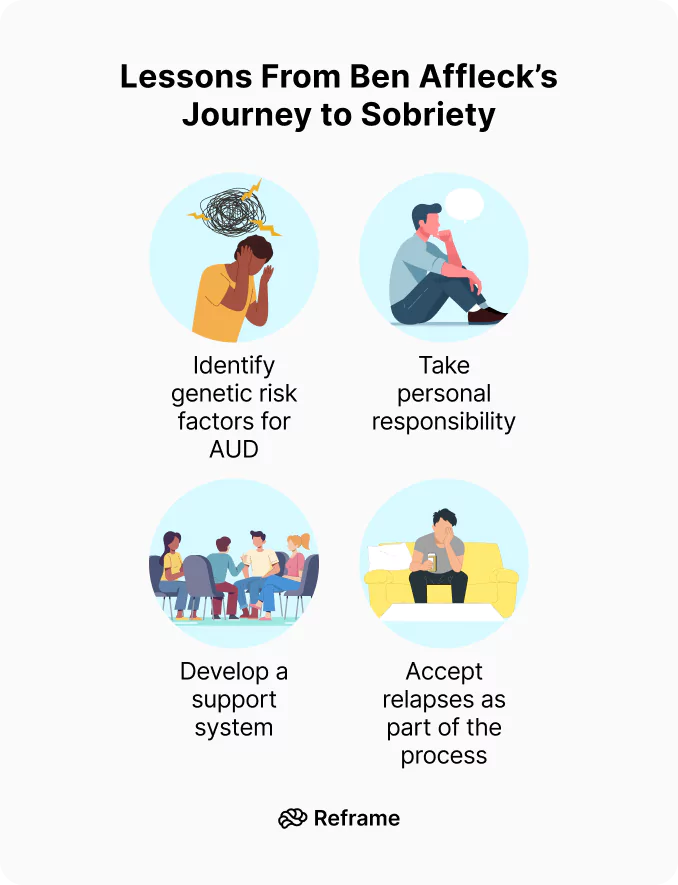
We often hear of celebrities committing to sobriety, but it’s not often we hear about their struggles with relapses. Affleck’s journey documents the highs and the lows — painting a more realistic picture of what recovery can look like. His story sheds light on major aspects of alcohol misuse and recovery:
Risk factors. Affleck’ attribute his alcohol misuse to both genetic and environmental factors. Identifying our individual risk factors can help us take steps to combat them.
Commitment to sobriety. Personal responsibility plays a major factor in Affleck’s commitment to sobriety and treatment. For us to develop a better relationship with alcohol, we need to acknowledge the need for change.
Support system. Affleck attributes his progress on his journey to sobriety to the support he receives from family and friends. Treatment also plays a role. Research shows that those who try to quit alcohol without support or treatment have higher rates of relapse. Having a support system can help us navigate and overcome challenges during recovery to keep us on the right path.
Relapses. Affleck said in an interview with The Hollywood Reporter, “Yes, I had a relapse. Yes, I went into recovery again. And then I went and did that movie.” As a well-respected public figure, Affleck shows us that there’s no shame in asking for help and that relapses aren’t the end of the road. Recovery is possible, and by encouraging open dialogue about his struggles with AUD recovery, Affleck is helping to remove any stigma around it.
Although relapses are a common part of recovery, we can take steps to help prevent them.
### Finding Motivation in Fatherhood
Ben Affleck's journey with alcohol has been deeply intertwined with his role as a father. He has openly shared that a primary motivation for his commitment to sobriety is being a positive role model for his children. Affleck has expressed a desire for his kids not to “pay for my sins” or carry the burden of worrying about his well-being, highlighting the profound emotional weight that fatherhood adds to his recovery. This powerful drive to protect his family and provide a stable environment transforms the personal challenge of sobriety into a selfless act of love and responsibility, giving him a compelling reason to stay the course even when it’s difficult.
### The Double-Edged Sword of Public Recovery
Navigating recovery in the public eye presents a unique set of challenges. Affleck has commented on becoming an unintentional "poster boy" for recovery, a role that comes with intense scrutiny. While sharing his story can help others, it also means every move is analyzed, often incorrectly. He pointed out that during an appearance at the Grammys where he was sober, many assumed he was drinking. This misunderstanding perfectly illustrates the stigma that still surrounds addiction and recovery. This constant judgment can make it harder for anyone to seek help and move forward, emphasizing the need for more compassion and open dialogue around the complexities of changing your relationship with alcohol.
Actionable Steps to Help Prevent Relapse
Although relapses are common in recovery, they can be dangerous. So, while there’s no shame in relapsing, we should do our best to prevent it. There are several ways to do this.
Identify triggers. Certain people, environments, and feelings can trigger cravings — leading to relapse. Identifying our triggers helps us avoid them or develop strategies to work through them. Keeping a log of our feelings and habits can help us identify our triggers.
Have alternative coping mechanisms. Alcohol misuse can often become a coping mechanism. When quitting drinking, identifying alternative coping mechanisms can help us avoid alcohol. Healthy coping mechanisms can include exercise, creative expression, mindfulness practices, giving back, and spirituality.
Manage stress. Stress is a common factor that can exacerbate individual triggers. Managing stress through deep breathing, meditation, movement, and getting adequate rest reduces emotional triggers that can increase the risk of relapse.
Practice self-care.Self-care helps us improve our health and overall well-being. Practicing self-care also serves to remind us to avoid unhealthy behaviors such as drinking.
Find purpose. Finding purpose in our life encourages us to focus on positive short- and long-term goals — and not give brain space to intrusive thoughts of drinking.
That said, if we relapse, there’s no need to end our journey to sobriety. There are some steps we can take to work through it.
What to Do If You Relapse: Your First Steps Back
Relapses are undoubtedly one of the toughest experiences in recovery. While it may feel like we’ve failed, it’s important to remember that the journey to sobriety isn’t always a straight line. Here are some tips to help us overcome relapses:
Understand the recovery process. Understanding how AUD changes the way our brain works helps us approach relapses more compassionately. While recovery requires self-honesty, it also requires self-compassion for us to learn and move on.
Reach out for support. Relapse can be dangerous as it can lead to dependence and result in alcohol poisoning and long-term health consequences. Reaching out for support immediately can help us get back on track as quickly as possible — limiting relapse to just a minor setback.
Remember our “why.” A major component of overcoming relapse is moving on. Remembering the reason why we’ve committed to sobriety can reinvigorate our motivation to push through in recovery. We can then take the lessons we’ve learned and apply them moving forward to prevent future relapses.
Stars like Affleck remind us that relapses can happen to any one of us. Despite the hiccups, we can continue to move forward on the road to recovery.
Recovery is a Marathon, Not a Sprint
While Ben Affleck may not have wanted the details of his struggles with (AUD) and recovery to be open to public scrutiny, his story brings awareness to a commonly stigmatized experience of recovery — relapse. Despite multiple relapses in Affleck’s journey, he committed to recovery and remains sober today. Although setbacks in our journey can feel like failure, we too can get back up and try again. As Affleck said in his 2013 Oscars speech when he accepted the Best Picture award for Argo, “It doesn’t matter how you get knocked down in life, because that’s gonna happen. All that matters is you gotta get up.”
Frequently Asked Questions
If I have a slip-up, does that mean I’ve completely failed? Absolutely not. It’s helpful to see a slip-up not as a failure, but as a data point. A single drink or a difficult evening doesn't erase all the progress you've made. Instead of letting it derail you, try to get curious about what led to it. Understanding the trigger is the key to adjusting your strategy for next time. This journey is about learning and adapting, not achieving perfection on the first try.
My family has a history of alcohol issues. Am I destined to have the same problems? Genetics can certainly be a factor, but they are not your destiny. Think of it as being handed a different playbook. Knowing your family history gives you a powerful awareness that allows you to be more intentional with your choices. It’s an opportunity to proactively build healthier habits and stronger support systems. You are in control of your own story, and your background doesn't have to define your future.
Why is relapse so common if someone has already been through treatment? Changing your relationship with alcohol is a process of retraining your brain, which is a long-term project, not a quick fix. Treatment provides essential tools, but life continues to happen with all its stress and unexpected challenges. A relapse is often a sign that old coping mechanisms have resurfaced under pressure. It doesn't mean treatment didn't work; it simply means that your strategies for managing your triggers need to be strengthened and adjusted for the long haul.
How do I handle social situations where people might judge me for not drinking? This can be incredibly challenging, as Ben Affleck’s Grammy story shows. The most important thing is to be confident in your own choice, for your own reasons. You don't owe anyone a lengthy explanation. A simple, "No thanks, I'm good" is a complete sentence. Having a non-alcoholic drink in your hand often prevents questions from even coming up. True friends will support your decision to prioritize your well-being, and their opinions are the only ones that matter.
What is the most important first step to take right after a relapse? The most critical step is to practice self-compassion and immediately reach out for support. Shame thrives in isolation, so connecting with a trusted friend, a support group, or your community is the best way to get back on track quickly. Acknowledge what happened without judgment, remind yourself why you started this journey, and view it as a temporary detour, not a dead end. The goal is to learn from the experience and keep moving forward.
Key Takeaways
Recovery isn't a straight line: Ben Affleck's public journey reminds us that setbacks are a normal part of the process, not a sign of failure. The most important step is to get back up, learn from the experience, and continue moving forward without shame.
Identify your personal triggers: His story highlights how genetics, stress, and social pressure can influence drinking habits. Take time to understand what prompts your own cravings so you can create a plan to manage those situations effectively.
Find your motivation and your people: A strong support system and a clear reason for change are powerful tools. Like Affleck, who is driven by his role as a father, connecting to your "why" and leaning on others for support can make all the difference.
Ben Affleck is recovering from alcohol use disorder (AUD).
2. Did Ben Affleck drink while working?
Drinking on set is common in the film industry, but Affleck says he did not drink on the job.
3. Did Ben Affleck attend a rehab program?
Yes, Ben Affleck publicly announced his participation in rehab programs on two different occasions.
4. Why did Ben Affleck relapse?
Relapse is not uncommon in recovery from alcohol use disorder. Affleck has shared that genetics and environmental factors such as stress may have contributed to his relapse.
5. What do I do if I relapse in recovery from alcohol use disorder?
Understand that relapse is a common experience in recovery and that it isn’t the end of the road. Reach out for support immediately to continue on the journey.
Avoid Relapse With Reframe!
Although it isn’t a treatment for alcohol use disorder (AUD), the Reframe app can help you cut back on drinking gradually with the science-backed knowledge to empower you 100% of the way. Our proven program has helped millions of people around the world drink less and live more. And we want to help you get there, too!
The Reframe app equips you with the knowledge and skills you need to not only survive drinking less, but to thrive while you navigate the journey. Our daily research-backed readings teach you the neuroscience of alcohol, and our in-app Toolkit provides the resources and activities you need to navigate each challenge.
You’ll meet millions of fellow Reframers in our 24/7 Forum chat and daily Zoom check-in meetings. Receive encouragement from people worldwide who know exactly what you’re going through! You’ll also have the opportunity to connect with our licensed Reframe coaches for more personalized guidance.
Plus, we’re always introducing new features to optimize your in-app experience. We recently launched our in-app chatbot, Melody, powered by the world’s most powerful AI technology. Melody is here to help as you adjust to a life with less (or no) alcohol.
And that’s not all! Every month, we launch fun challenges, like Dry/Damp January, Mental Health May, and Outdoorsy June. You won’t want to miss out on the chance to participate alongside fellow Reframers (or solo if that’s more your thing!).
The Reframe app is free for 7 days, so you don’t have anything to lose by trying it. Are you ready to feel empowered and discover life beyond alcohol? Then download our app today!
Reframe has helped over 2 millions people to build healthier drinking habits globally
At Reframe, we do science, not stigma. We base our articles on the latest peer-reviewed research in psychology, neuroscience, and behavioral science. We follow the Reframe Content Creation Guidelines, to ensure that we share accurate and actionable information with our readers. This aids them in making informed decisions on their wellness journey. Learn more
Updated Regularly
Our articles undergo frequent updates to present the newest scientific research and changes in expert consensus in an easily understandable and implementable manner.